

Robot Glossary Acceptance: Specify Orientation Representation
2026-11-01
Robot Glossary Acceptance: Specify Orientation Representation
An orientation field in a robot glossary can look self explanatory until two delivery documents use different representations. One may show quaternion components while another describes roll, pitch and yaw. A procurement reviewer needs to know what each entry means before agreeing that the terminology is usable. This is a review of explanatory material, not an instruction to change a robot's orientation or calibrate its sensors.
Ask what the glossary entry is meant to explain
Start by identifying the item a reader will encounter in the delivered documentation. An entry might explain a message field, a mathematical representation or a label in a visual tool. Those purposes should be stated. A short definition that blends all three can leave the reader uncertain about whether an example describes stored data, a displayed conversion or an actual physical pose.
For a fictional training glossary supplied with a robot model, the reviewer could request a source reference and a statement of the representation used by each example. A tidy illustration is helpful only if its labels agree with that statement. The glossary should not rely on a reader recognizing the intended convention from the visual arrangement of symbols alone.
Keep the quaternion component order explicit
The Jazzy ROS 2 quaternion tutorial describes its four components in the order x, y, z, w, and notes that some libraries place w first. This is a practical reason to name the representation and component order in a handover. It is not a reason to rearrange an unfamiliar data file without its own format explanation.
If the supplier's glossary contains an unlabeled sequence, ask which convention its producer intended. Retain the original sequence and the response. A receiver should not silently attach ROS labels to a value produced by another library. Where conversion is part of the agreed delivery, the supplier should explain the input and output representations so that a later technical reviewer can assess the conversion separately.

Distinguish a representation from an everyday rotation description
REP 103 sets out ROS conventions for rotation representations, including quaternions and specified fixed axis roll, pitch and yaw conventions. It also warns that Euler angle conventions vary. The procurement implication is to ask for an explicit convention where a glossary uses angle language, rather than treating every phrase containing yaw or roll as interchangeable.
The editor can record which reference the supplier follows and where the example explains its axes and sequence. A glossary entry may introduce an intuitive description, but the reader still needs to know how it relates to the representation used in the associated software documentation. Familiar wording cannot substitute for that relationship.
A conceptual drawing should therefore be labelled as explanatory. It should not show an invented robot pose with a numerical annotation that readers might mistake for a measurement. The original figures in this article deliberately use questions and document relationships instead of fabricated rotations.
Resolve an ambiguous example before approving its reuse
Suppose the fictional glossary includes a quaternion sequence beside an angle description copied from another guide. The reviewer should ask whether the two refer to the same convention and the same example. The correct response may require rewriting the explanation, replacing the example or clarifying that the materials discuss different representations. The reviewer should not select a conversion merely to make the page look consistent.
Keep an editorial issue tied to the affected entry and its source. When the supplier responds, check the revised labels and surrounding wording together. A corrected symbol order does not automatically resolve an unexplained angle convention. Conversely, a clearer paragraph may resolve the reader's question without changing any underlying software data. Those outcomes belong in different parts of the acceptance record.
Publish a glossary conclusion with a defined boundary
The glossary handover should also preserve who supplied an explanatory example. An editor may simplify wording for beginners, but should mark that simplification as an explanation rather than attribute it verbatim to the referenced convention. If an illustration is replaced, revisit its labels alongside the entry. A clearer drawing can still be misleading when the surrounding text describes a different representation.
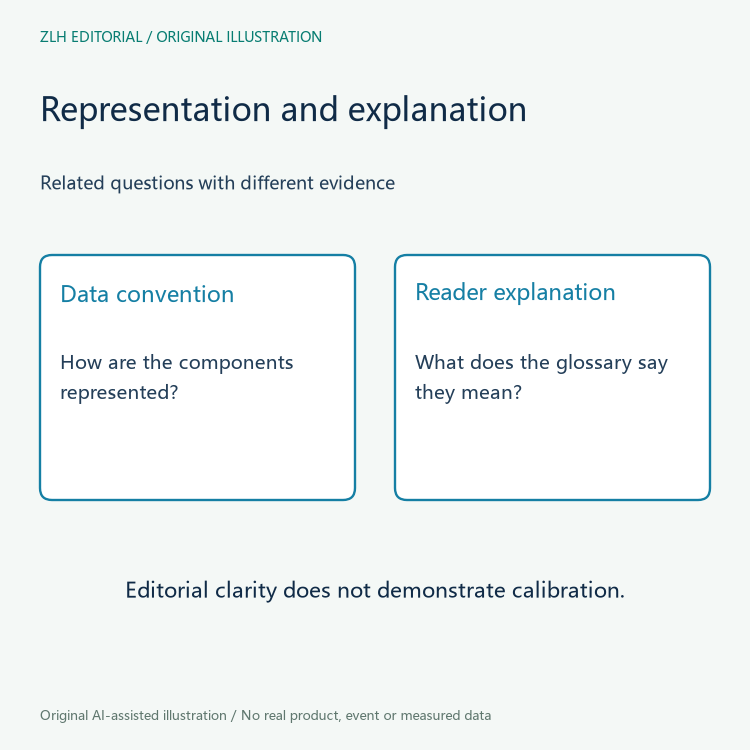
A useful acceptance statement says which entries now identify their representation, component order and reference convention. List unresolved examples by their document location. Do not report physical accuracy, alignment or successful motion from this editorial review. No transformations have been computed here, and no hardware has been observed.
The robot terminology collection and article index offer routes to related documentation topics. A glossary becomes more useful when the next reader can distinguish the representation being described from the editorial explanation surrounding it. The conclusion should make that distinction easy to follow without suggesting that the vocabulary review tested a robot.


