

Robotics Review 2026: Form and Autonomy Name Different Ideas
2026-11-02
Robotics Review 2026: Form and Autonomy Name Different Ideas
A robot’s appearance can be easy to describe while its behavior remains difficult to explain. Calling a system humanoid identifies something about its form, but does not by itself explain how it selects an action or what task it can complete. The 2026 Stanford Emerging Technology Review offers a useful setting for clarifying that language. This article reads its public robotics page and IFR’s definition page on November 2, 2026. It proposes a vocabulary exercise without assessing a real robot or assigning a safety status.
Begin with the physical system rather than the attractive label
The Stanford 2026 robotics review describes robots in terms of physical sensing and effects on the world, and emphasizes integrating component technologies. It also discusses the promise and obstacles associated with humanoid systems. That framing encourages readers to look beyond appearance when discussing what a machine does.
The IFR public definition page discusses a degree of autonomy and distinguishes different uses and forms of service robots. This article reads that public explanation rather than claiming to have examined the full ISO vocabulary standard. The point is to make a conversation clearer, not to issue a formal classification certificate.
Imagine a fictional teaching session in which a learner sees a conceptual drawing of a robot. Before attaching a broad capability label, the group could ask what the drawing actually tells them. It may communicate a body arrangement while leaving sensing, control, and intended activity unexplained.
That gap is ordinary. An illustration often exists to explain one aspect of a system. The reader’s mistake would be to treat missing information as evidence of a capability that the illustration never addressed. No drawing in this article represents a real product or functioning prototype.
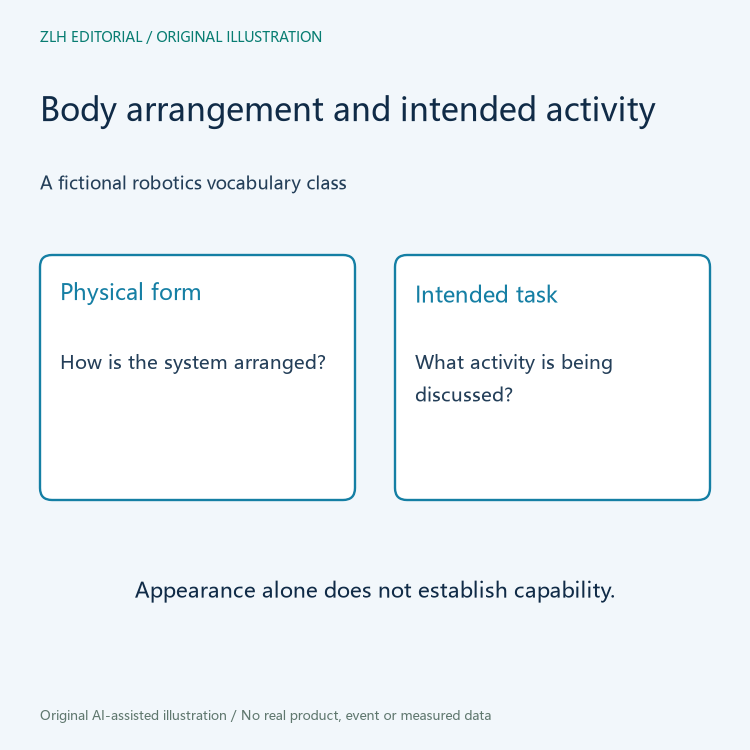
Form describes an arrangement; a task describes an activity
A form word can help people discuss how a machine is arranged. A task description instead explains an intended activity. The same broad form may be considered for different activities, and the same activity may lead designers to consider different arrangements.
For the fictional class, one exercise could ask learners to rewrite a vague phrase into two separate statements: what form is being discussed, and what activity is intended. Keeping both statements prevents the physical description from silently taking over the capability claim.
The exercise does not require a list of invented specifications. If the activity is unknown, the learner can say so. An honest description with an open question is clearer than a detailed story that assumes a machine can carry out tasks merely because it resembles a familiar object or person.
It is also useful to avoid treating the task as a complete account of the design. Saying that an activity is intended does not prove that it has been achieved. A real performance statement would need its own relevant observations and conditions, which this vocabulary exercise does not provide.
Autonomy concerns how an intended activity is performed
The autonomy question introduces another dimension: what the system does in relation to sensing, its current state, and human involvement. It cannot be answered solely by naming a body shape. A reader needs an account of the particular activity and the relationship between the machine and the people involved.
In the imaginary session, the teacher can ask which parts of an activity are described and which remain unspecified. The group should not assign a universal autonomy label from a short demonstration description. A system may be discussed differently across activities, so the intended scope matters.

This is a language clarification rather than a test plan. The article gives no instructions for operating equipment and no conclusion about how a real robot responds to its environment. The diagrams organize questions; they do not depict a verified controller, measured response, or certified level.
Likewise, the word autonomous should not carry an unspoken approval claim. A description of human involvement and sensing is not a declaration that an application is appropriate for a particular setting. Those are further questions, with evidence beyond the terminology discussed here.
Write a description that leaves each question visible
A clearer short explanation can identify the physical arrangement, the intended activity, and what is known about how the activity is performed. These statements complement one another. None should be used to fill a missing answer in another category.
The 2026 review is useful because it places physical systems, integrated technologies, and current research challenges in one discussion. A reader can use that context to ask better questions without converting a promising field into an assertion about an individual machine.
Our robot vocabulary section develops related distinctions, while the reading directory offers more topics. Both original conceptual illustrations are teaching aids. They contain no real robot, autonomy measurement, deployment outcome, or assessment of a product’s suitability.


