

Robot Frame Practice: Describe Static and Changing Relationships
2026-11-02
Robot Frame Practice: Describe Static and Changing Relationships
A robot frame name does not, by itself, tell a reader whether its relationship to another frame is treated as static or changing. This article proposes a vocabulary exercise for ROS 2 Jazzy teaching material. It uses no real robot, publishes no transforms, and supplies no positions or motion trace. The learner’s task is to explain the relationship being discussed before attaching a label to it.
Describe the pair and the intended relationship
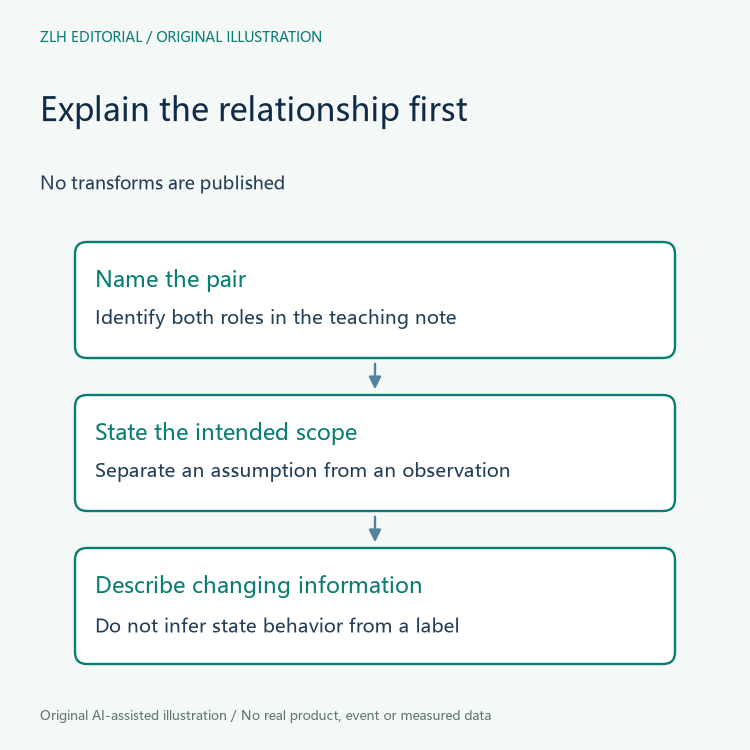
Begin with a conceptual card naming two frame roles. Ask what relationship the teaching note intends to describe and why that relationship matters to the lesson. The learner should not infer the answer solely from words such as base or sensor in a familiar name.
In the fictional class, the instructor can state the intended relationship without supplying a physical device. Learners should retain the distinction between that stated teaching assumption and an observation of an actual system. The exercise does not claim that any real component is fixed in place.
A useful first explanation names both sides of the relationship. Calling one frame static without saying relative to what can leave the central question unclear. The article proposes using ordinary words to make the pair explicit before discussing a software representation.
Ask another learner to restate the relationship. If they describe a different pair or a different activity, clarify the lesson material first. A technical-looking diagram should not conceal a disagreement about which objects the words refer to.

The instructor can then change one role in the proposed pair and ask whether the original explanation still applies. Learners should not transfer an assumption to a new relationship without a reason. This checks whether the description named the pair rather than a familiar component.
Read static as a relationship assumption with a scope
The Jazzy static-broadcaster tutorial discusses relationships involving non-moving parts. That gives the learner a context for the term. It does not establish that a particular real assembly satisfies the same assumption.
For the imaginary card, ask what would need to remain unchanged for the stated relationship to be appropriate. This is a conceptual question about the lesson’s scope. It is not an instruction to inspect, move, or secure a physical component.
The learner should keep that scope beside the term. A label copied out of context can become misleading when another reader assumes it describes a broader arrangement. The note should not turn a teaching assumption into a finding about the stability of actual equipment.
If the assumption has not been supplied, retain the question. There is no need to invent transform values or a model layout to complete the explanation. A clear request to the instructor is a useful next step.
Keep changing state information distinct from the frame name
The Jazzy broadcaster tutorial develops a teaching example that broadcasts state information. The learner should distinguish that activity from merely choosing names for frames. The name is not a substitute for the information the example represents.
In the fictional exercise, the instructor could ask which aspect of the relationship is expected to change and what the lesson intends to illustrate. The answer should stay at the level actually supported by the prepared material. This article contains no time series or observed movement.
The exercise does not decide between broadcaster implementations for a real system. It also does not claim that one short label proves timing behavior, accuracy, or a correct physical arrangement. Those would be additional questions requiring appropriate actual information.
A learner who has read a tutorial can explain its example without claiming to have run it. Keeping that difference visible makes the vocabulary lesson honest and prevents a copied diagram from being mistaken for an observed frame tree.
Check whether the explanation survives a change of names
At the end, replace the familiar labels with neutral role descriptions and ask a colleague to explain the relationship again. If the meaning disappears, the first account may have relied on the names rather than the relationship. Return to the pair and the stated scope.
A useful summary can say what relationship is assumed, which information concerns changing state, and which questions remain open. It should not add an unperformed observation merely to make the discussion look technically complete.
This proposed lesson improves terminology. It does not calibrate a robot, test a transform publisher, or certify that any part is non-moving. The diagrams organize concepts rather than simulate a result.
Related explanations appear in our robot vocabulary section and the article directory. Both original illustrations contain no real frames, numerical transforms, timestamps, motion, or software execution evidence.


