

Gazebo Jetty Notes: Portability Needs More Than an API
2026-11-03
Gazebo Jetty Notes: Portability Needs More Than an API
A simulation interface can make a portability discussion more precise without proving that a robot task transfers unchanged between simulators. Gazebo Jetty’s official materials provide a useful example. The cited repository release entry is dated October 14, 2025, so this is a current reading of an older official source, not a claim that Jetty launched today. No simulator is installed, no robot code is transferred, and no task result is measured.
Keep the release entry and its linked explanation together
The gz-sim10 release entry directs readers to the Jetty announcement, highlights, and getting-started material. An editor should preserve those source roles. A short repository entry can identify the release context while the linked documentation explains the feature being discussed.
Do not infer a reader’s installed environment from that source. A project announcement is not an inventory of a local workstation, its models, or its integrations. The receiving author still needs to name the implementation used by an actual tutorial or software delivery.
For this source review, the question is deliberately narrow: what does the published interface goal tell a reader, and what evidence would a separate task-transfer claim require? That question avoids treating a common software label as a complete description of a robotics experiment.
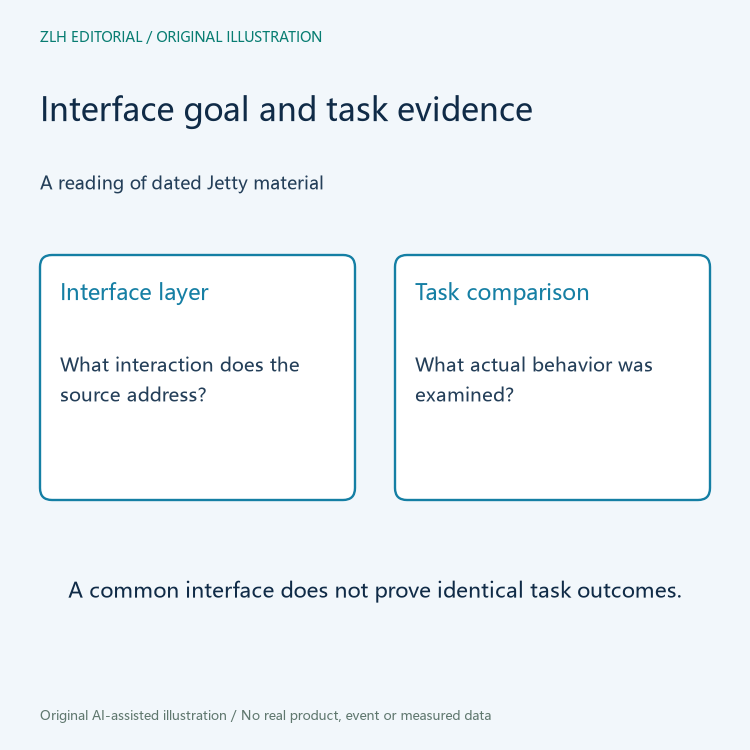
Read the portability goal as a goal with a scope
The official Jetty release notes describe a standard simulation interface from the ROS community intended to improve portability between simulators. This identifies an interface-level direction. It is not a report that every user’s robot model, sensor interpretation, or application outcome remains identical after a transfer.
A reader preparing a glossary should keep interface compatibility and task equivalence as separate terms. One concerns the interaction a program can express. The other concerns what an actual task does under identified conditions. The evidence needed for those statements can overlap without being interchangeable.
The distinction does not diminish the documented feature. It makes the explanation more useful by letting the reader understand which layer the source addresses. A bounded summary can acknowledge an interface improvement while leaving unexamined behavioral questions open.
Name the task before saying that it transferred
A future authorized comparison should identify the intended task in ordinary language. Is the author examining a model-management operation, a data exchange, or a complete application behavior? Different tasks can use an interface without sharing the same success criteria.
The report should connect that task to the actual model and environment. A familiar robot name or a visually similar scene is not enough to identify all relevant conditions. Ask what material remained the same and what was changed rather than infer equivalence from a demonstration image.

This article carries out none of those comparisons. It provides no interface calls, scene files, or successful migration transcript. A diagram of the proposed questions should not be reused as an architecture drawing for a system that was never inspected.
Keep source claims and local observations attributable
If a later exercise demonstrates an interface operation, record the actual implementation, input, and observed result. That observation belongs to the exercise. The project’s broader motivation remains a different kind of statement and should retain its own citation.
Conversely, a local problem should not automatically be described as disproving the interface goal. The responsible reviewer needs evidence about the specific condition. A failed attempt and its cause are separate entries in a useful technical record.
Preserve unresolved differences instead of editing them out of the demonstration. A clear account of what remains unexplained is more valuable than an apparently seamless transfer whose conditions cannot be reconstructed.
Avoid turning simulation portability into physical assurance
Even an appropriately documented software comparison would not by itself establish that physical equipment performs as simulated. A robot’s actual environment, hardware, and intended use need their own relevant evidence. This source review makes no physical-performance or safety claim.
The same boundary applies to a training package. Completing a tutorial can support a learning outcome without approving a deployed robot system. An editor should name the learning activity rather than promote it into an unperformed commissioning exercise.
Publish a dated interpretation readers can follow
The useful summary connects the older release context, the documented interface goal, and the separate evidence question. Its value comes from clarity, not from presenting a historical source as breaking news or supplying an invented transfer result.
More explanations appear in our robot software concepts section and the reading directory. The original illustrations contain no real simulator screenshots, transferred robot code, execution timings, or completed portability tests.


